Thursday, June 18, 2015

Right Wing Extremism, fed by fear and hate, is our biggest threat.


“You rape our women and you’re taking over our country. And you have to go.” -- Dylann Roof, suspected Charleston shooter.  


"When Mexico sends its people they're not sending the best. They're not sending you, they're sending people that have lots of problems and they're bringing those problems. They're bringing drugs, they're bringing crime. They're rapists and some, I assume, are good people, but I speak to border guards and they're telling us what we're getting."  --Donald Trump in his candidacy speech two days ago.

"We have to TAKE OUR COUNTRY BACK!"  Nearly every GOP candidate within their election cycle, echoing the constant mantra of Rush Limbaugh, Glen Beck, Ann Coulter, and most at Fox News.


Just a few days ago, the NY Times published an op-ed about the threat of right-wing extremism. In The Other Terror Threat, Charles Kurzman and David Schanzer write: "The main terrorist threat in the United States is not from violent Muslim extremists, but from right-wing extremists. Just ask the police."

"In a survey we conducted with the Police Executive Research Forum last year of 382 law enforcement agencies, 74 percent reported anti-government extremism as one of the top three terrorist threats in their jurisdiction; 39 percent listed extremism connected with Al Qaeda or like-minded terrorist organizations. And only 3 percent identified the threat from Muslim extremists as severe, compared with 7 percent for anti-government and other forms of extremism.

"Despite public anxiety about extremists inspired by Al Qaeda and the Islamic State, the number of violent plots by such individuals has remained very low. Since 9/11, an average of nine American Muslims per year have been involved in an average of six terrorism-related plots against targets in the United States. Most were disrupted, but the 20 plots that were carried out accounted for 50 fatalities over the past 13 and a half years.

"In contrast, right-wing extremists averaged 337 attacks per year in the decade after 9/11, causing a total of 254 fatalities, according to a study by Arie Perliger, a professor at the United States Military Academy’s Combating Terrorism Center. The toll has increased since the study was released in 2012."

The days of fooling ourselves into thinking that all of these are just "lone-wolf" attacks by disturbed people are coming to an end. The trends have been apparent for a long time, but a potent mixture of self-denial, racism, jingoism, and a passionate love affair with guns have conveniently allowed us to ignore the forces that help create such hate.

Sometimes understanding and perspective have to sneak into the backdoor before they can be recognized as reality. The higher the cognitive dissonance within a group of people, the less likely they will accept anything other than their chosen beliefs, no matter what evidence is presented.  (That's why comedians are such powerful agents for social change. If you can make people laugh they will drop their ideological shields for a brief moment.)  We've been forced to confront an uncomfortable truth of ideological causation brought about from the hypocrisy of blaming groups, and their ideological underpinnings, such as the "black community" or the "Muslim community" for acts of terror.

Right-wing extremism and hate groups have exploded since President Obama took office, and the currency that fuels this growth is hate and fear. Both of these are strong political tools for spreading individual interests and specific power-structures to benefit a small minority of very rich people. You don't have to go far within media to find national broadcasters talk about how we've lost "our" country to "them." You don't have to go far to find overt racist remarks about our President. You don't have to go far to find people preaching that this country is on the verge of collapse, that it will soon be overrun by people of color, and that the good-ole white-folk will be put in concentration camps. To the rational, this sounds crazy. To people who are naturally paranoid and full of fear, this sounds increasingly reasonable.

Right-wing extremism and the violence acted out is a by-product of gaining power through the spread of fear and hate. Glen Beck, Alex Jones, Limbaugh, Coulter, Ted Nugent and Fox News have built empires preying on the ignorant and fearful. It is classic cult-building phenomenon that has been studied for centuries:

1) Create the "in-group."
2) Show them the world is "out to get you."
3) Claim insider information that only you have and everyone outside the group will deny.
4) Consistently ratchet up the fear to grow in numbers and strength.

Most in the media do this only for ratings, and I'm sure none of the aforementioned would ever want acts of violence to come from their fear-mongering.  But when fear-mongering is mixed with mental illness, isolation, and boiling anger, the unfortunate resulting reaction is often violence.

Roof's statement, "You rape our women and you’re taking over our country. And you have to go," (emphasis mine) is all too familiar within the right-wing extremist communities.

The national voices that endlessly loop these fears every single day need to be put in check--not by silencing them, but by publicly shaming them. We need to mock the absurd notions that Obama is going to come take all our guns, that Obama is going to take over Texas with a secret military drill called "Jade Helm," or whatever other paranoid conspiracy theory of the day is going around. They have a right to say them. We have a right and duty to publicly shame them.  Fear-mongering for profit needs to go out of style. Rational thought needs to come back in.

If the nation's law enforcement agencies are more worried about right-wing extremism than Muslim terrorists, then we need to confront reality and, as a national community, help ratchet the fear-mongering back down. It has been done before with the KKK and is currently happening with the anti-vaxxer movement, and there's no reason we can't do it again. As fractured as this country feels, we still have the power to spread awareness and combat ignorance and hate.

--Brian Paul Swenk

Keep up with me here:
Twitter

Tuesday, May 19, 2015

As the GOP voting bloc dwindles, will they find a unifying message for 2016?

Daniel J. McGraw has penned an interesting article for Politico about the higher mortality rates for Republican voters and how it will play into the general election numbers of 2016. The wide discrepancy of average age between Democratic voters and Republican voters is one of several big factors currently in the Dems favor, and it is one that cannot be overcome by marketing and on-point message.


The GOP has two main problems: a basic numbers problem (they’ve only won the popular vote once in 25 years, with a much larger base voting bloc under wartime conditions, when a country will typically rally behind their leaders) and the intoxicating strategy of divisiveness that has been so successful in the mid-term elections when voter turnout is so staggeringly low.   


These two problems are unique but still interrelated, and they combine to pose a major obstacle in a serious run for the White House in 2016.   


As the older, and predominantly Republican, American population ages out of voting ability (a fancy way of saying "dies") they are replaced by two primary groups: millennials coming of age and the large numbers of Hispanic immigrants who are now citizens--both of which overwhelmingly vote (when they do vote) Democratic. Losing voters on both ends of the spectrum is a massive problem for the GOP. This issue is not being openly addressed by the GOP, and it doesn’t even seem to be recognized by the party as a whole.   


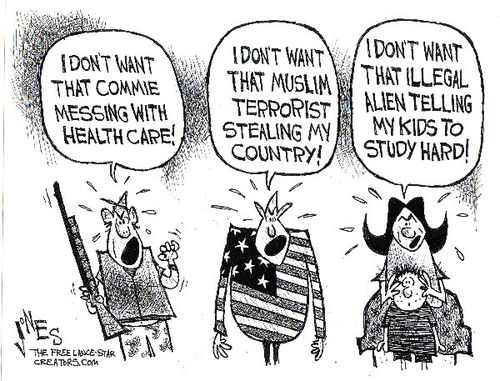
The inability to confront this issue comes from a myopic laziness that has grown from easy and fast midterm election gains.  The divide-and-conquer midterm election strategy has morphed into its own beast in today’s hyper-politicized environment, and the intoxicating effect of winning has paralyzed today’s hopeful candidates. The GOP have become masters at understanding that the key to midterm gains is to not confront national issues or win votes from the 1-2% of undecided voters as with a general election, but to energize their hard-core base. You don’t do this with policy, problem-solving, or congressional effectiveness. You do this with emotion and division. They are the problem (poor, immigrants, gays), and we are the solution (job creators, guns, evangelicals).That’s the message; stay on it and reap the rewards. The more divisive language you can spread through the base, the better chance of getting that base to vote in a mid-term election.


cartoon commie health care.jpg


The problem is that no one has told these 20-some-odd current GOP candidates that this strategy will not work in today’s national election for one simple reason: more people vote. And yet, Mike Huckabee is banking on the strategy so heavily that he’s written an entire book about the differences of the “bubbas--" good ole rural white folks who form the backbone of this country--and the “bubbles--" the liberal, tree-huggin', artsy, welfare-sucking city slickers who are bringing this country down. Now just imagine for a brief second the candidates coming down the home-stretch of the national election and one of them campaigning with that message. (Some will argue that his entire campaign is just a publicity stunt to further his public persona career. I’ve yet to see any sign that he is anything but genuinely convinced this strategy could work.)  


Huckabee serves as a caricature of what the party has devolved to, as his divisiveness is more Hee-Haw-silly than hateful. But the eventual nominee will have to rise above that divisiveness and recognize that winning a national election will have to involve some type of unifying message, which becomes another problem for Republicans.


As a country, we are tired of war, and we are tired of all the economic gains going to the 1%. We are tired of the constant hate for poor people, minorities, immigrants, gay people, and women’s rights. We are tired of the wedge issues, such as abortion. We finally see through the masquerade of trickle-down economics. We see the crumbling infrastructure with no desire to fund it. Gun rights only go so far, and for that matter, we’re tired of the NRA running Congress. So tell me: what will be the rational, reality-based, unifying GOP message that will bring in the undecideds and independents?

They are running out of options, they are running out of viable candidates, and they are running out of core-base voters. If voter turnout stays at the historic low levels of the recent midterms, then it could be close. If the Dems can create another participation-is-hip vibe, as Obama did in ‘08, it won’t be. 

There is a good possibility that we’ve entered a long-term stalemate of GOP state and local control and democratic presidential control. Of course, this is more or less how our government was created to exist--with balancing forces. But the political forefathers did not envision a time when our leaders refused to confront and solve national problems. If you inject enough greed, toxicity, and power-grabbing, even democracy has its limits.

--Brian Paul Swenk


If you like the posts, please share and sign up for emails on the left.


Keep up with me here:
Twitter

Thursday, May 7, 2015

Why the Ferguson and Baltimore riots are different than every other riot in history


Have you noticed that the recent riots in Baltimore and Ferguson seem different than every other riot we learned about in school or see in the movies? Have you taken a moment to wonder why this is? Well, try this: find an uprising by the poor against an establishment that’s either over 150 years old or in a fictional narrative (Hunger Games, Star Wars, The Matrix, etc?) and take notice of who you identify with. Take notice of who you cheer for and who you empathize with. Take notice of where your sense of respect lands for the bravery and sacrifice of the oppressed. Is there one single populist uprising, historical or fictional, that you honestly side with the establishment?

Our nationalistic narrative teaches us from an early age that our freedom came from rising up against establishment powers. Our country was built on it. It’s ingrained in us to view history through the lens of the underdog, the oppressed, the poor, and the marginalized on a truly consistent basis. It is so natural that we don’t even notice it. But as we watch what is happening in our own country--in Ferguson and Baltimore--we have a completely different and visceral reaction: these riots are different. These riots are not the same as every other riot we’ve ever learned about. These riots are perpetrated by thugs who have no justified reason for violence and destruction. All the other riots had a purpose, but not these, no way.

So here’s the big question: if this turns into a flashpoint of American history, and the riots continue and alter our society in a historically noticeable way, how will the people view them in 200 years? Will they see them with our perspective? Or will they view them the exact same way we view the uprisings of 200, 300, 400 years ago?

The uncomfortable truth that we all need to face is the only thing different here is our perspective. These are the only riots out of the historical thousands that are different because they are against us. The truth is that we are the establishment here. We work in the establishment, we vacation in it, and we buy houses, cars, trucks, boats and motorcycles in it. We put our kids into it and trust it to take care of our elders. We tell ourselves that we are individual and unique and that this very individualism and uniqueness will allow us to thrive inside this establishment. We all want to be special, but how can we be special if we don’t have an establishment to recognize it?

As we see good, honest people invoke the words of Dr. King over a CVS store being burned but not for the constant reports of unarmed black kids being killed, we have to recognize and admit that we identify more with the CVS store than the dead kids. That attack on the CVS store, which played in endless loops on cable news, is us! We are that CVS store. These riots are different because they are attacking us. Our invocation of the words of Dr. King and Ghandi over a CVS store, but not kids being killed, shows us everything we need to know about how history will view this.  

As we live in, invest in, and build our establishment that has a consistent historical record of standardized violence against poor minorities, we can’t stand back and be shocked, with any type of intellectual honesty, that we receive it back. We, at the very least, have to admit that we hold a strong double standard when it comes to violence. We celebrate and make a hero out of the black mom who beats the shit out of her kid on national TV, but we would be appalled if it happened in a rich, white suburb.

“Over the past four years, more than 100 people [in Baltimore] have won court judgments or settlements related to allegations of brutality and civil rights violations. Victims include a 15-year-old boy riding a dirt bike, a 26-year-old pregnant accountant who had witnessed a beating, a 50-year-old woman selling church raffle tickets, a 65-year-old church deacon rolling a cigarette, and an 87-year-old grandmother aiding her wounded grandson.

“The money paid out ($5.7 Million) by the city to cover for the brutal acts of its police department would be enough to build a state-of-the-art rec center or renovations at more than 30 playgrounds. Instead, the money was used to cover for the brutal acts of the city's police department and ensure they remained well beyond any semblance of justice.”  -- Ta-Nehisi Coates quoting the Baltimore Sun report: Undue Force


I get the sense that a lot of us just don’t understand what true marginalization means (or the difference between “understanding” and “condoning” events, for that matter). We just can’t understand why these people don’t work, don’t get an education, don’t....just be rich. We can understand marginalization within the historical sense, or in the Hunger Games, but not in today’s world. Because understanding it in today’s world means that something might be wrong. And admitting something could be wrong might, just might, alter the social power structure that deep down we all worship and obey. Who among us wants that?

John Oliver on the realities of marginalization in Ferguson


--Brian Paul Swenk

If you like the posts, please share and sign up for emails on the left.

Keep up with me here:
Facebook
Twitter

Tuesday, March 31, 2015

A *no spoiler* review of The Walking Dead and why it is so successful.


The following review does not have any spoilers.

You can make the argument that we are currently in the golden age of television or you can argue that we are in the second golden age of television; either way, there's no denying that the best writers of our time have migrated towards the medium.

Today's television is punctuated with emotionally complex characters who engage in masterful dialogue about current, meaningful topics or the great mysteries of life and consciousness...and The Walking Dead is not one of those shows.


This season is my first experience with this show, and as the season finale came to a close last night, it got me wondering why this show is so deservingly successful in a landscape of emotional heavy-weight television. As I've grown older, I've realized that I enjoy writing of any medium that brings deeper insight and understanding of either pertinent, topical issues or the universal human experience. Whether it's the complexities and reality of the dark side of human nature, as in True Detective, or the hyper-dramatized reality of cutthroat, power-hungry politics of House of Cards, I feel as I have a rather high expectation of what I will dedicate my time to. Which is why I've been pleasantly surprised with my full engagement and enjoyment of The Walking Dead. 

The reason TWD is so successful, I think, is because it generally has a very clear sense of self-awareness. It is a show about survival, but more importantly the creators know it is a show about survival. That might sound simplistic, but if there's a lesson that you learn with age and experience in art is to know yourself, know what you can do, and then do it well. This show knows that surviving in the world which it created is supposed to be basic and simplistic. They dig into the deepness of the first basic human instinct and are able to find the rich complexity of survival instead of manufacturing it through esoteric, philosophical writing and over-dramatic acting. And for that, I'm impressed.

Andrew Lincoln as Rick Grimes
The two main criticisms you'll hear about this show are about weak writing and weak acting, namely from the Rick and Daryl characters. These criticisms, in a general sense, are not off base, but I will argue that it is a situation where an obvious weakness has, fortunately, turned into a strength. Great stories are great because they not only sell you on the premise, but they bring you into the story. They allow you to become invested with both the heart and the mind, into whatever world they create. In short, they have the power to make the unbelievable believable. There's a raw honesty to TWD and I think it has a lot to do with the simple, primal drive of characters such as Rick and Daryl. They are not characters that are emotionally reactive and they do not require consistent emotional transformations, because that's not the type of person that will survive the impossible odds that the story creates. Deep down, we, as an audience, either consciously or subconsciously connect with this group of people who are not Hollywood pretty or Hollywood emotional. Instead, they remind us of us, or at least what we would like to be if we faced a world of zombies. There's a realness there that not only sells the story, but takes us down the road with them.
Norman Reedus as Daryl Dixon
 The Talking Dead
TWD, as I said earlier, has a massive fan base, which is not uncommon;  the difference is this fan base is completely engaged with this show on a level that makes other shows envious. There is a live show, The Talking Dead, that follows every episode. Actors discuss the current episode and it features real-time tweets, Skyped questions from fans, and quiz contests. Name another show that has that! This show is successful not because it is trying to match complicated, poignant dramas note for note, but because it knows what it is and what it can bring. It is the John Hartford of bluegrass. It is the ZZ Top of rock. It is the Stephen King of prose. The Walking Dead has its own personality and drive, and it taps into our primal desire for survival, which in the end, really is a big question of life.


--Brian Paul Swenk

If you like the posts, please share and sign up for emails on the left.

Keep up with me here:
Facebook
Twitter


Thursday, March 5, 2015

Frank Solivan - Leading The Way In Today's Bluegrass

Frank Solivan talks about being on the cutting edge of today's bluegrass, the history and tradition that drives him, and what's in store for the future. 

Bluegrass music, like many art forms, experiences waves of both popularity and innovation, but those waves are not necessarily in sync with each other. In recent times, we've seen the O Brother Where Art Thou wave of popularity bring the music into new places, as millions of Americans heard Dan Tyminski's voice through George Clooney's face--an almost sure-fire way to bring an underground art to the mainstream, even for a brief moment. As the years moved on, and the hipness of bluegrass faded back to the core fans and pickers, we hit a spot where a little soul-searching overtook both the players and fans. We had to ask ourselves, what is the future of our music? These discussions have been both positive and vibrant, but while they were taking place, there have been a handful of bands working their way up that, I think, will show us the future of bluegrass.

One of these bands is Frank Solivan and Dirty Kitchen. A couple months ago I started listening to their three studio releases: Frank Solivan and Dirty Kitchen (2010), On the Edge (2013), and their newest release, Cold Spell (2014). These albums do not always conform to the typical traditional bluegrass sound, yet the musicianship and traditional knowledge have sprouted a very progressive sound that is being accepted in the traditional bluegrass community. This is a feat that is only impressive if you understand the insular nature of the bluegrass industry, where tradition still rules and Nickel Creek keeps getting pushed into the "Americana" category.

I caught up with Frank as he was touring with the Jerry Douglas-led band, The Earls of Leicester (pronounced "Lester"), a Grammy-winning tribute to the heyday of "Lester" Flatt And "Earl" Scruggs. Frank has just joined up with them to take the place of Tim O'Brien, who has Hot Rize commitments.  The slight irony of interviewing someone on the forefront of progressiveness while touring with a traditional throwback band was amusing to both of us. But that's what makes bluegrass so beautiful: no matter how far you go, you're only one degree away from the masters who started it.

"It's been a Flatt and Scruggs bootcamp lately!" Frank jokes. "We've spent a lot of time listening, and also talking about, what their music was about and getting into the little details of Lester and Earl. We're recreating something for people to hear the blueprint of bluegrass music, the initial architecture, before it progressed into another form that we hear on the radio now."

The Earls of Leicester -- Big Black Train and Black Eyed Susie
Raleigh Convention Center -- Oct 4, 2014


Frank and Dirty Kitchen are just coming off a Grammy nomination for their most recent release, Cold Spell. His band features Mike Munford on banjo, Chris Luquette on guitar, and a lifelong friend, Danny Booth, on bass.  One of the first things you notice about the album is they don't stick to the typical boom-chunk, boom-chunk timing that is synonymous with bluegrass. The first track of the album Say It Isn't So, written by Frank's cousin Megan McCormick, makes the statement that this band is not afraid to try new things.

Say It Isn't So


Frank doesn't consciously arrange his songs to push any boundaries within the music. "Everyone comes together and does something that is unique to them, and we'll play as a unit. We're always working on dynamics and the feel of the song."

Dirty Kitchen seems to be that rare occurrence of experienced, master musicians who can put all ego aside and work as a single, creative unit. "Nobody tries to be in front of anyone else," Frank explains. Everyone has a chance to shine in our show and on our records, but when the song is being played, everyone is playing soft."

 Chris Luquette, guitar; Mike Munford, banjo; Frank Solivan, mandolin; Danny Booth, bass.
A lot of bluegrass is written with the bluegrass sound and rhythms in mind, but for Frank it depends on what kind of mood he's in.  "I hear all kinds of stuff, I hear a lot of blends too. Our common denominator is bluegrass, but I've spent a lot of time playing country music, and I've listened to a lot of funk and Beatles. Lately I've been listening to Michael Jackson and Stevie Wonder."

Frank grew up in California in a very musical family. His grandmother on his father's side played both mandolin and fiddle and participated in acrobatic vaudeville shows with her sisters. His mother's side had classical violin and cello players throughout the family. The bluegrass bug bit him early, as he got a Bill Monroe cassette tape and then started collecting Monroe 8-tracks as well. "We wore out some Bill Monroe, Flatt and Scruggs, and Elvis 8-tracks," he remembers. At 9 years old he heard Newgrass Revival for the first time, "...and they just blew my mind! I'd seen those instruments played before, but they melted my face off! I saw them doing what they wanted to do and not being constricted by what people thought."

Frank started going to the west coast bluegrass festivals at that point, and another band that really made a big impression on him was the Johnson Mountain Boys with Dudley Connell, Tom Adams, Marshall Wilborn, and the great Eddie Stubbs on fiddle.  "They were contemporary in that they were using what they learned in traditional bluegrass, but then brought it to the next level with cleaner harmonies and more structure. I was thinking 'I want to be able to do that!' and make my music as good and creative as it can be."

A couple years ago, the previously mentioned "soul-searching" was kickstarted by Chris Pandolfi, the banjo player for the Infamous Stringdusters (one of the other bands who are key to the future of bluegrass). Pandolfi wrote a bluegrass manifesto of sorts, calling on the bluegrass community, and specifically the IBMA (International Bluegrass Music Association), to become more open to both younger players and bands who don't hold to the strict tradition of the music, such as Yonder Mountain String Band, Avett Bros, and Mumford and Sons.  Bands who have elements of bluegrass in their music, but have reached out to much wider audiences. In typical political fashion, there was a division between the strict traditionalists and the progressives. It's no surprise where Frank falls in the debate. "I think it's common sense when it comes to accepting different types of music.  We do have the so-called bluegrass industry. IBMA wants to further bluegrass music and they're doing a fairly good job lately, especially with the conventions in Raleigh. It seems the umbrella of bluegrass has gotten bigger, but there will always be people who say 'Well, that ain't bluegrass!' But you know what? It is music!"

Frank recalls Chris Thile talking about how genres aren't as clear cut anymore. Thile's description of how the clear-cut walls of genres are starting to blur, as classical musicians are starting to play with folk musicians, and jazz musicians are starting to play with bluegrass musicians, and it made a big impression on him.  "I'd like to see more people trying that stuff.  Traditional bluegrass isn't going anywhere.  When we get into jam sessions we're going to pull out all the traditional stuff because that's common knowledge, and it's not going anywhere. The people that played in the 50's and 60's; they were pushing the boundaries of music, too.  They were doing something different and it caused a stir, and people loved it.  So if the music doesn't progress we won't have an industry or younger generations that listen and find their way back to those roots."

One aspect of being a leader in your field is that the amount of work it takes can almost insulate you from what's going on in the industry around you. "We're working so hard to get down the road and keep everything moving forward that it's kind of insular, so I don't see it from the outside.  We've gotten some of the accolades, which is totally awesome and incredible, but it's hard to see it how the fans see it. It takes a lot of energy to run a business and keep everyone paid."

In 2013, Mike Munford was voted "Banjo Player of the Year" and guitarist Chris Luquette received the "Momentum Award" for Performance Instrumentalist. At the 2014 IBMA awards, the band received 4 nominations: Frank Solivan for Male Vocalist of the Year and Mandolin Player of the Year, Mike Munford for Banjo Player of the Year, and the entire band won Instrumental Group of the Year. Their 2014 release, Cold Spell, was nominated for a Grammy in the Bluegrass Album category. All of this is a testament to the band becoming leaders in the industry, as well as the industry accepting different song structures that are not strictly traditional.


No Life In This Town


Frank Solivan and Dirty Kitchen are what bluegrass music needs these days. They are master musicians who fully understand the history and tradition but aren't afraid to explore new sounds and concepts. We've always had people who fit that description, either outliers or people like Bela Fleck and John Hartford that by sheer force created their own styles. But we haven't necessarily had a cohesive, single unit that had the force to shift the entire bluegrass spectrum, with ease and grace, in a long time. I think we've entered into a paradigm shift with Frank and Dirty Kitchen and some of their peers, such as Infamous Stringdusters, Balsam Range and Steep Canyon Rangers. With excellent songwriting and musicianship, we'll see the rules and expectations loosen and the audiences and fan bases grow.

"M80" A banjo-driven instrumental


While the recording industry retracts each year with fewer album sales, connecting with your fan base becomes even more important. For this, Frank has a few tricks up his sleeve. Frank is known as a great chef and has spent years combining his music and food talents.  "I want to bring people together and have an intimate experience. Connecting with your fans in any way you can is important. I just want to be a good human and have that come across the most. People get to a certain point and just assume you're stuck up or unapproachable, and I don't want any of that. I just want to connect with people on a level that is natural and human."

--Brian Paul Swenk

If you like the posts, please share and sign up for emails on the left.

Keep up with me here:
Facebook
Twitter

Better (Days Go By)


The making of the new album "Cold Spell"

Monday, February 23, 2015

The Four Recent Losses in Journalism and Why It Matters


If there were ever a time to write about journalism, this is it. Four of the most respected journalists in the biz are either gone or in the process of leaving-- and all are exiting on top or while falling down.
The recent losses of journalistic leaders has caused me to look back at the steps that led me to become fascinated with the adventure, the curiosity, the writing, and the intellectual challenges of both the people and ideology that make up the journalism profession.

When I was a kid I looked up to two types of people who I thought were the apotheoses of human achievement: astronauts and professional athletes. This made sense to me, since both were easily understandable to a kid who might not have full reasoning powers, but can comprehend both adventure and the easily graspable idea of winning and losing.

Beginning in in my late teenage years throughout my 20s, that focus shifted a with a sharp sense of urgency to musicians. I began asking myself, "What's the use of working towards self-realization if you aren't able to actively participate in the beauty of the creative process--such as music?" And with that I just fell head over heels in love with bluegrass and was determined to become an active member of that art form.

But now, as I get through my 30s, there's been another question that has replaced that one: "How do you fully participate in human creativity if you don't actively try to understand the complexities of the world and people around you?" The great writers, thinkers, and creative class who have had such a major impact on our culture typically have a knack for understanding the complex layers of the individual, society, and culture. Dylan, Guthrie, Twain, and currently even Jon Stewart all immersed themselves into American culture and the plight of the lower and middle class working people. All of these men were dedicated to using both experience and interactions to tell the beautiful and heartbreaking stories of the American people.

Written word, spoken word, satire, and music all have the power to bring change. Journalists might not have the same enduring legacy as authors and musicians, but they still play a significant part in all the major cultural shifts; many have been killed as testimony to that.


Musicians, writers, and journalists all tell existential stories about human nature, just in different formats. Woody Guthrie, Bob Dylan, investigative reporters such as Taibbi, Hersh and Woodward, and satirists such as Twain and Stewart have all effectively brought more cultural and social shift to this country for the under-represented than most politicians.


Of all the hits that we've seen, Brian Williams is the messiest and most complicated. We've seen the most-watched news anchor of our current time possibly lose his job over a story that had nothing to do with the news. What it does concern are the ethical implications of a public who wants our public figures, politicians, and news anchors to also be entertainment celebrities. Williams walked that line better than anyone, but when it came time to creatively embellish stories, as every one of us does, the online punditry and twittersphere smelled blood and came in for the kill.

There was something that bothered me about this whole deal. Mostly because it was not necessarily about some newfound national desire for absolute "truth" in the media. Not when Fox News tells the truth a reported 18% of the time and is the #1 cable news outlet. No, there was something else going on and I think it was our bloodthirsty appetite to see a good man get torn down.

I saw very few people concerned about the trust that Williams had broken as the "Lyin' Brian" memes caught fire. There was much more of an engaged bloodsport spectacle of people feeling like they get to be a part of this action, like a crowd gathering at the gallows all clamoring to help pull the lever. If bringing a bad person down feels good, bringing a good one down is even better.

Jon Ronson wrote about the spectacle of public shaming in the New York Times:

"As time passed, though, I watched these shame campaigns multiply, to the point that they targeted not just powerful institutions and public figures but really anyone perceived to have done something offensive. I also began to marvel at the disconnect between the severity of the crime and the gleeful savagery of the punishment. It almost felt as if shamings were now happening for their own sake, as if they were following a script."

Ronson followed several people who had been publicly torn down over offensive tweets, one of which was a young PR girl, Justine Sacco, where he describes the snowballing energy that drives our desire to participate as a virtual group in actions we would not do alone.

"But perhaps she had now come to understand that her shaming wasn’t really about her at all. Social media is so perfectly designed to manipulate our desire for approval, and that is what led to her undoing. Her tormentors were instantly congratulated as they took Sacco down, bit by bit, and so they continued to do so. Their motivation was much the same as Sacco’s own — a bid for the attention of strangers."

While that level of accountability is required for investigative journalists to keep massive institutions in check, it is not required by the public for our news sources-- remember that Fox News is the #1 cable news program--and that is ultimately why the national outrage over the Williams story did not feel either genuine or equal to the crime.

Just a few shades over in the industry, where a single embellishment or mistake can ruin a career, we have the great investigative journalists of our time, Matt Taibbi of Rolling Stone. In a testament to fastidiousness, he had trouble getting the RS fact checkers to sign off on one of his most famous lines, where he described the investment bank Goldman Sachs and its role in the financial crisis:

“The world's most powerful investment bank is a great vampire squid wrapped around the face of humanity, relentlessly jamming its blood funnel into anything that smells like money.”


Taibbi: "I remember is the fact checkers coming to me at one point and they almost killed the line because squids don’t have blood funnels. I was trying to explain that was part of what made it funny, but they were very insistent. I had to go over their heads on that one."

Such scrutiny is required for investigative pieces because one factual error can wreck the entire work. If Goldman Sachs can find one substantiated error, falsehood, or lie then that's all they need to cast doubt on the entire article. Taibbi and RS know this (which makes the UVA rape article both out of character and somewhat unforgivable) so they task their fact checkers to go over every single sentence. That is why one writer is able to take on what is arguably the most powerful corporation in the world with both truth and substance.

On the other side, we have two of the most respected journalists of our time, Bob Simon and David Carr, suddenly pass away; while it might not feel like much to most people, these two were giants in the industry.

Much like with Stewart, you did not want to be caught in David Carr's crosshairs. While one was based around comedy and satire, the other was soberingly serious; but both raised the bar for media practices through their hard work and most importantly, intellectual honesty. The ire of either of these two meant you were caught either being lazy, or worse, dishonest, and in today's profit driven twitter speed news cycles we need more of these watchdogs, not less. Here's a great interview Carr did with Terry Gross on her show "Fresh Air".

Jon Stewart has had such an effect on news media that just his announcement of his impending departure sent the internet into such a frenzy of remorse posts that he opened the following day's show by asking, "Ummm....did I die yesterday?" Satirist, comedian, watchdog, voted "most trusted news-person"--I don't think anyone has been able to properly describe the impact Stewart has had on our current media landscape. Many have tried, and you can pull up countless posts that all do a great job of discussing various effects.

We love the arts for so many reasons, one of which is they give us a deeper insight into the human condition and experience. But strip away the smoke and mirrors of entertainment and we have a class of people who overflow with curiosity and bravery, and are able to understand the hugeness of the world and bring it to our doorstep. The older I get, the more I've begun to appreciate both the ability to do this as well as the western philosophy of freedom of speech that allows it. Criticism and cynicism aside, David Carr was adamant that the golden age of journalism is not necessarily behind us.

--Brian Paul Swenk

If you like the posts, please share and sign up for emails on the left.

Keep up with me here:
Facebook
Twitter

Sunday, January 18, 2015

Why Grateful Dead Chose Trey Anastasio


This week the remaining members of the Grateful Dead announced what could be their final farewell shows. The announcement had two surprises: the length, or lack thereof, of the 3 day run and the addition of Phish guitar player Trey Anastasio filling in for Jerry. Most of the rumors circulating around the Deadhead circuit were based around the notion of having a revolving cast of players who've filled those shoes for the last couple decades: Warren Haynes, Jimmy Herring, Steve Kimock, and John Kadlecik. But instead they chose one, and he happens to be the leader and the voice  of that other jam band.


In the days to come, I expect to start seeing some Trey backlash coalescing and becoming more vocal. The backlash will be visceral by nature, and more interestingly will peel back the layers of how we personally identify with art. Art does not exist without a personal connection. Personal connections do not exist without our emotions and expectations--fair or not. These personal connections make up part of our personal identity. So for many people, on a deep level, choosing Trey to play Jerry's guitar parts disrupts many decades of personal identity. As this becomes clearer to Deadheads, we can expect to see the emotional recognition and reactions vocalized.

The great disconnect between artists and fans is that decisions such as these --which musicians are best suited to play with a band-- are not made with these emotional connections in mind. Great artists have a completely different relationship with their art, and in many cases, they aren't able to even understand how some people connect with their art.

The different perspectives on this particular art--the music of the Grateful Dead--is why the remaining musicians chose Trey, while many, and maybe even most, of the old-school deadheads would have chosen someone else--someone without the Phish sound, baggage, and personality.  For the musicians making this choice it all comes down to one single thing, and read this slowly:

The notes that come out of the instrument.

That's it. That is the alpha and omega of that decision-making process. It is not about the scene, the personality, or the history. It is purely the fact that the notes that come out of Trey's guitar are better than anyone else's! These guys believe that music comes from the universe, and a great musician is a conduit that has found the ability to tap into it. Carlos Santana has said, "I was picturing the audience as this sea of flowers, the music was the water, and you guys were the hose." The remaining members chose the guitarist that can tap into that idea more naturally and creatively than anyone else. Period!

You can argue that statement if you want, but your argument is based on the feeling that you don't have the personal connection to those notes as you do to someone else's, mainly Jerry's (not to mention you are telling your musical heroes that they are wrong). Those personal connections are what drives our love of music, but to understand how musicians connect to their music you have to lose that bias for a moment.

I don't think any world-famous rock and roll band has been more dedicated and true to the actual music than the Grateful Dead, and again, I'm talking about the notes that come out of the instrument. Rock and roll has always walked such a fine line between style or music as the driving force. Where some bands would be nothing without their style, (i.e. KISS and hair-bands) the GD, through the de-facto leadership of Jerry, showed us what can happen if you concentrate solely on the music. Their love of American folk, jazz, big band, classical, and even tribal rhythms, combined with a sheer inexhaustible force of experimentation were always the driving force (drug addictions aside) for the Dead. That's how they formed and ran for decades, so do you really expect them to put all that aside because a guitar player comes with cult of personality baggage?

No, the remaining members don't give a shit about that. They picked a guy they feel has the most direct line to the musical source they believe in. The guy that can tap into the same place they tapped into in the 60's as they found their sound. Bob Weir notes, "Trey's well-schooled in the style of music we play--listening intently to what's going on and reacting meaningfully to what other people are playing. If there's a key shift or modality shift within a given section, (he) can hear that and relate, as I say, meaningfully."

Our connection to art will always be personal, and it will always show our biases, experiences, and emotions. There will be many who will be furious they chose Trey. There will be many who will boycott the whole deal because of Trey. And all that is fine. But if you understand how they approach their music, then you can see that they made a great and logical choice. These shows will be creative and push musical boundaries, just the way Jerry would want it.

All that being said, this is the funniest video you will see about this whole deal. This is amazing:


--Brian Paul Swenk

If you like the posts, please share and sign up for emails on the left.

Keep up with me here:
Facebook
Twitter