Wednesday, September 30, 2015

How science denial is turning the GOP into the world's pariah

If you think Donald Trump leading the GOP primary race is the worst thing happening in American politics at this point, you’re wrong. There is something much broader, more subversive, and much more damaging to our country that is being left unchecked by the mass media.

On September, 16th, CNN hosted a marathon 3-hour Republican primary debate that broke records for viewership primarily for the reality-show-appeal of Trump’s campaign pugilism. What stuck out to me, and what should have made the headlines, were the two medical doctors that stood on a stage in front of 23 million people and denied the very science they’ve dedicated their professional lives to.

Maybe we can accept people like Trump, Christie, and Huckabee denying science and obfuscating national realities for their own personal agenda. But, as a nation (as an advanced nation!) we should not give this irrational leeway for Rand Paul and Ben Carson to pander to the anti-science/anti-intellectual crowd that forms the GOP primary base.

Both Paul and Carson have had extremely successful careers as surgeons for the tenderest of organs, eyes and brain respectively. Surgical career success such as theirs does not happen if someone is sloppy or careless, either physically or mentally. It happens by someone immersing themselves into the scientific world of medicine and trusting the process and evidence presented to them. These are affluent men of science, yet they have the audacity to stand on stage in front of millions and try to convince us they “aren’t sure” about climate change, or if vaccines cause autism? A belief in conservative/libertarian models of economics and social constructs is one thing, but denying the processes of your life’s work for primary votes exposes both your dishonesty, and your willingness to pander for votes at any cost.

If we dig deeper to understand why, we’ll find that the GOP is the only conservative party in the advanced democratic world to continuously deny the realities of modern climate science. The only one.

“A new paper by Sondre Båtstrand studies the climate-change positions of electoral manifestos for the conservative parties in nine democracies, and finds the GOP truly stands apart,” writes Jonathan Chait for New York Magazine. “Opposition to any mitigation of greenhouse-gas emissions, he finds, ‘is only the case with the U.S. Republican Party, and hence not representative of conservative parties as a party family.’ For instance, the Swedish conservative party ‘stresses the necessity of international cooperation and binding treaties to reduce greenhouse-gas emissions, with the European Union and emissions trading as essentials.’”

You’ll find that throughout the world of democratic nations, conservatism lives up to its name within their ecological sphere of influence.

Chait continues, “Germany’s conservative platform declares, ‘[C]limate change threatens the very foundations of our existence and the chances of development of the next generations.’ Canada’s, writes Båtstrand, ‘presents both past and future measures on climate change. The past measures are regulations on electricity production, research and development on clean energy (including carbon capture and storage), and international cooperation and agreements including support for adaptation in developing countries.’ Even coal-rich Australia has a conservative party that endorses action to limit climate change.”

There will always be conservatives and progressives. In fact, our country was setup to both function and thrive on these opposing pressures. But the right-wing extremism pervading our current political reality is forcing us outside the realm of a functioning, world-class democracy. Donald Trump may be a symptom, but the anti-science extremism that has infected even the smartest is, ultimately, the sickness.  

--Brian Paul Swenk

Keep up with me here:
Facebook
Twitter

If you like the posts, please share and sign up for emails on the left.

Wednesday, September 9, 2015

Stephen Colbert's debut for The Late Show wasn't perfect, but it was great!

If you want to understand someone’s personality, you could do worse than ask who their favorite late night TV host is. The landscape of late night talk shows has always been a better reflection of America than anything else on TV. In very recent memory, the conservative Leno was balanced by Letterman’s subversiveness, and Conan came to be our quirky wild-child. Then came Jon Stewart’s brand that allowed us to be both entertained and also engaged with meaningful, spot-on commentary of real-world events as they unfolded. Stewart’s brand of comedy and the Colbert spin-off eventually became a personality litmus test for people, much like asking “Letterman or Leno?” Stewart was substance with comedy as the rich dessert, Colbert was comedy with substance as the rich dessert.

Last night, Stephen Colbert introduced himself to the country for the first time...or maybe it was the second time: therein lies the ultimate question we’ve been waiting 9 months to answer. There’s the Stephen Colbert that we all know, a character so deep and complex in his conservative simplicity that we never got tired of the schtick even after 10 years, and then there’s the Stephen Colbert that we barely know--a kid that grew up in a very large, Catholic family in SC, loved his mother dearly, and got the Daily Show gig early in his career and hasn’t looked back. Can the Stephen we barely know carry The Late Show? A show that exists because of the sheer force of an entertainment legend, David Letterman. And, can the Stephen we barely know compete with a soon-to-be entertainment legend, Jimmy Fallon?

But ultimately the real question became can the Stephen we barely know exist beyond the Stephen we know so well? In other words, can he operate without the comfortable mask of his character?   

The debut of The Late Show with Stephen Colbert last night wasn’t perfect, but it was much better than good and I’ll dare say it was great. He showed us that he has the chops to stand up to the Letterman legacy and also to compete with Fallon. But most importantly, he showed us that we’ve been watching the real Stephen Colbert this entire time and didn’t know it. All those years of watching what we thought was a carefully crafted character turned out to be a joke on us, the audience. The conservative, blowhard, “Bill O’Reilly” riffing was just that, riffing. But they were riffs delivered through a real, compassionate, and smart human being--the real Stephen Colbert. Otherwise, the character would have become a pale, stiff caricature of itself and wouldn’t have lasted for 10 years and won 8 Emmys. Last night was our “a-ha!” moment when we could finally see The Colbert Report for what it truly was--a great man and a great entertainer gently distilling the worst parts of conservatism for our comedic pleasure.    

Colbert gagging himself with Oreo's during Trump clips
Not since Johnny Carson has late night talk been able to cruise each week. Today’s multi-media landscape demands instant entertainment delight minute-by-minute, and Jimmy Fallon, with his creative carnival-like contests, has all but mastered this. I’ve spent this summer wondering how I would compete with him if I were Colbert, which is obviously a losing proposition. You can’t out-Fallon Fallon. But, where Fallon has taken the approach to stay clear of current and political events, other than a few monologue one-liners, Colbert showed us last night that he’s going to embrace our crazy political world. In one of the funnier bits last night, Colbert took on the comedic goldmine of Donald Trump and did not appear to soften the blows for network television, and boy did that feel good. In the absence of The Daily Show and The Colbert Report we desperately need someone to step up and take a stand against the absurdities being passed to us for political consumption, and last night Colbert showed us that he’s still on our side.

The choosing of Jeb Bush for the debut show drove home the fact that this show will tackle the current American reality head on. In between clever impromptu jokes, Colbert talked to Jeb Bush about his campaign, about the reality of the Bush Dynasty, about education, and about the systematic failure of partisan politics. It was a good interview that walked a fine balance of substance and joking around--the vibe of two smart guys having a beer in the backyard. Cloony’s interview was not one of the stronger parts of the night, but it did foreshadow the use of creative pre-filmed bits that will spice up interviews.
Jon Batiste leads "Everyday People"
The show ended with a blow-out musical jam featuring Mavis Staples, Derek Trucks, Susan Tedeschi, Buddy Guy, Paul Janeway (St. Paul and the Broken Bones), Brittany Howard (Alabama Shakes), Ben Folds, and the great band of New Orleans' Jon Batiste--all taking part in the classic song "Everyday People." You can watch it here: http://video.vulture.com/video/Late-Show-Musical-Performance

Overall, I don't think he could have had a better debut show. Colbert gave respect where he needed to, placed jokes where he needed to, and the populist vibe throughout the show was driven home with the funky big-band jam at the end. American television is dripping with talent at this particular point and Stephen Colbert just showed us that he's ready to take the step up to become one of the greats.
--Brian Paul Swenk

Keep up with me here:
Facebook
Twitter

If you like the posts, please share and sign up for emails on the left.

Friday, August 7, 2015

What the hell happened to True Detective?

True Detective has one extended 90-minute episode left to wrap up a mess of a season. Even with the last two episodes, "Church in Ruins" and "Black Maps and Hotel Rooms," catching a spark reminiscent of the first season, the finale would need to be a hail Mary miracle shot to keep this season from being remembered as anything but disappointing.


Nobody needed or even expected season 2 to top season 1. The first season rightfully sits on top of the throne of this second golden age of television. Creator Nic Pizzolatto's introduction into television was like a pinch-hitter hitting a grand-slam to win game 7 of the World Series. We tuned into it because of the star power of McConaughey, Harrelson, and HBO and stayed because Pizzolatto's writing took all three to new, unexpected heights.

"Who is this guy and how did he just make one of the greatest shows in history?"


If Season 1 was a 10 (and it was!), Season 2 could have come in at a 7 and we would have been satisfied. But instead, we are stuck with a mess of a story that most of us are only keeping up with on good faith.

The most obvious pot-shot to take at this season is the confusing amount of characters who may or may not be integral to the story line. Three weeks ago, Buzzfeed put out an article titled
This Is For Everyone Who Is Totally Confused By Season 2 Of “True Detective.”  I'll wager most of us were provided some clarity by this simple recap of characters and events, which intertwine, at this point, with the grace and direction of pixie pickup sticks.

"Maybe you even thought the city of Vinci was a character, too," writes Buzzfeed author Kirsten King.

Velcoro, Vera, Caspere, Bezzerides, Osip Agronov, Delvayo, Chessani, Amerilla--all beautiful names no doubt, but when you combine them with hushed mobster-like whispers, Colin Farrell talking with marbles in his mouth, and random shuffled mentions in deeply insinuated dialogue, it gets confusing quickly. I'm pretty sure I thought "Vinci" was a character at some point, too.


A multitude of characters and complex, interwoven storylines are far from narrative sin. In the right hands that combo has the power to change the course of television, e.g. Game of Thrones or The Wire. The sin that is yet to be atoned for is not giving the audience something to care about--which is, most surprisingly, the complete opposite experience of the first season.

The first season's magic was that, in some form or other, we cared for, empathized with, or at least felt pity for nearly every character that came across the screen. We tenuously held onto a sense of reality with Rust Cohle. We felt the guilt of Marty Hart as he tried, and failed, to be the moral man he wanted to be. We even understood the pain and helplessness of people like Charlie Lange.
Charlie Lange
There is one episode left in this season, and we are still trying to find something to attach ourselves to. The relationships between the three investigators have been distant at best and robotic at worst-- other than the most recent scene of Bezzerides and Velcoro finally giving into some natural human urges other than violence. The secondary familial relationships seem to keep the over-arching show themes of dysfunctional detachment and loneliness alive, but otherwise they just eat up time. The murder victim is shady and corrupt, so who cares if we find his killer? Frank Semyon, played by a much-too-dry Vince Vaughn, should be one of the characters we're rooting for but has mostly stayed one-dimensional.  And somehow we're supposed to be interested in the motives behind land and parcel transfers, highway development, and guaranteed overages?

Season 2 is working so hard to establish its own unique identity, in many ways succeeding in that. But that success of identity separation only comes at the price of losing the spark of the intrepid, existential banter that drove season one. It's an interesting paradox, that to truly understand its failings we have to refer back to what it is running from in the first place. 

A writer I highly admire, Erik Adams, reviewed the first episode of the second season for AV Club with the following: 

"'The Western Book Of The Dead' feels like a kid starting classes at a school where an older sibling’s reputation precedes them. Big brother was popular with the brains and the jocks alike, an effortless charmer who also had a bit of philosophical mystique to him. He left cryptic scribblings in his notebook margins and gave a stoned pronouncement about the human condition as his yearbook quote, yet he was still crowned prom king." 

History will probably treat this season better than our first impressions, and it could fall into the "Oh, now I get it" category, as happened with The Wire, Deadwood, and Freaks and Geeks.  Maybe upon second viewing we'll see the vision and intent with more clarity. Maybe we will start to appreciate the power of the inescapable demons lurking in these characters' pasts as they push them forward or hold them back in every moment.

Pizzolatto set out to create a whole new identity with season 2, not just with stylistic adjustments as most artists do, but a Garth Brooks-to-Chris Gaines complete identity swap. From an artistic standpoint, that takes guts--major guts! From a success standpoint, you are either going to hit another grand slam or go down swinging. Maybe not a lose-the-game strikeout, but a put-your-team-behind strikeout. Whatever happens this Sunday night, we should remember that the second season of HBO's The Wire was its weakest as well, and that show changed television. I'm already looking forward to seeing where the demons of season 2 will inspire season 3.


--Brian Paul Swenk

Keep up with me here:
Facebook
Twitter

If you like the posts, please share and sign up for emails on the left.


Thursday, June 18, 2015

Right Wing Extremism, fed by fear and hate, is our biggest threat.


“You rape our women and you’re taking over our country. And you have to go.” -- Dylann Roof, suspected Charleston shooter.  


"When Mexico sends its people they're not sending the best. They're not sending you, they're sending people that have lots of problems and they're bringing those problems. They're bringing drugs, they're bringing crime. They're rapists and some, I assume, are good people, but I speak to border guards and they're telling us what we're getting."  --Donald Trump in his candidacy speech two days ago.

"We have to TAKE OUR COUNTRY BACK!"  Nearly every GOP candidate within their election cycle, echoing the constant mantra of Rush Limbaugh, Glen Beck, Ann Coulter, and most at Fox News.


Just a few days ago, the NY Times published an op-ed about the threat of right-wing extremism. In The Other Terror Threat, Charles Kurzman and David Schanzer write: "The main terrorist threat in the United States is not from violent Muslim extremists, but from right-wing extremists. Just ask the police."

"In a survey we conducted with the Police Executive Research Forum last year of 382 law enforcement agencies, 74 percent reported anti-government extremism as one of the top three terrorist threats in their jurisdiction; 39 percent listed extremism connected with Al Qaeda or like-minded terrorist organizations. And only 3 percent identified the threat from Muslim extremists as severe, compared with 7 percent for anti-government and other forms of extremism.

"Despite public anxiety about extremists inspired by Al Qaeda and the Islamic State, the number of violent plots by such individuals has remained very low. Since 9/11, an average of nine American Muslims per year have been involved in an average of six terrorism-related plots against targets in the United States. Most were disrupted, but the 20 plots that were carried out accounted for 50 fatalities over the past 13 and a half years.

"In contrast, right-wing extremists averaged 337 attacks per year in the decade after 9/11, causing a total of 254 fatalities, according to a study by Arie Perliger, a professor at the United States Military Academy’s Combating Terrorism Center. The toll has increased since the study was released in 2012."

The days of fooling ourselves into thinking that all of these are just "lone-wolf" attacks by disturbed people are coming to an end. The trends have been apparent for a long time, but a potent mixture of self-denial, racism, jingoism, and a passionate love affair with guns have conveniently allowed us to ignore the forces that help create such hate.

Sometimes understanding and perspective have to sneak into the backdoor before they can be recognized as reality. The higher the cognitive dissonance within a group of people, the less likely they will accept anything other than their chosen beliefs, no matter what evidence is presented.  (That's why comedians are such powerful agents for social change. If you can make people laugh they will drop their ideological shields for a brief moment.)  We've been forced to confront an uncomfortable truth of ideological causation brought about from the hypocrisy of blaming groups, and their ideological underpinnings, such as the "black community" or the "Muslim community" for acts of terror.

Right-wing extremism and hate groups have exploded since President Obama took office, and the currency that fuels this growth is hate and fear. Both of these are strong political tools for spreading individual interests and specific power-structures to benefit a small minority of very rich people. You don't have to go far within media to find national broadcasters talk about how we've lost "our" country to "them." You don't have to go far to find overt racist remarks about our President. You don't have to go far to find people preaching that this country is on the verge of collapse, that it will soon be overrun by people of color, and that the good-ole white-folk will be put in concentration camps. To the rational, this sounds crazy. To people who are naturally paranoid and full of fear, this sounds increasingly reasonable.

Right-wing extremism and the violence acted out is a by-product of gaining power through the spread of fear and hate. Glen Beck, Alex Jones, Limbaugh, Coulter, Ted Nugent and Fox News have built empires preying on the ignorant and fearful. It is classic cult-building phenomenon that has been studied for centuries:

1) Create the "in-group."
2) Show them the world is "out to get you."
3) Claim insider information that only you have and everyone outside the group will deny.
4) Consistently ratchet up the fear to grow in numbers and strength.

Most in the media do this only for ratings, and I'm sure none of the aforementioned would ever want acts of violence to come from their fear-mongering.  But when fear-mongering is mixed with mental illness, isolation, and boiling anger, the unfortunate resulting reaction is often violence.

Roof's statement, "You rape our women and you’re taking over our country. And you have to go," (emphasis mine) is all too familiar within the right-wing extremist communities.

The national voices that endlessly loop these fears every single day need to be put in check--not by silencing them, but by publicly shaming them. We need to mock the absurd notions that Obama is going to come take all our guns, that Obama is going to take over Texas with a secret military drill called "Jade Helm," or whatever other paranoid conspiracy theory of the day is going around. They have a right to say them. We have a right and duty to publicly shame them.  Fear-mongering for profit needs to go out of style. Rational thought needs to come back in.

If the nation's law enforcement agencies are more worried about right-wing extremism than Muslim terrorists, then we need to confront reality and, as a national community, help ratchet the fear-mongering back down. It has been done before with the KKK and is currently happening with the anti-vaxxer movement, and there's no reason we can't do it again. As fractured as this country feels, we still have the power to spread awareness and combat ignorance and hate.

--Brian Paul Swenk

Keep up with me here:
Twitter


Tuesday, May 19, 2015

As the GOP voting bloc dwindles, will they find a unifying message for 2016?

Daniel J. McGraw has penned an interesting article for Politico about the higher mortality rates for Republican voters and how it will play into the general election numbers of 2016. The wide discrepancy of average age between Democratic voters and Republican voters is one of several big factors currently in the Dems favor, and it is one that cannot be overcome by marketing and on-point message.


The GOP has two main problems: a basic numbers problem (they’ve only won the popular vote once in 25 years, with a much larger base voting bloc under wartime conditions, when a country will typically rally behind their leaders) and the intoxicating strategy of divisiveness that has been so successful in the mid-term elections when voter turnout is so staggeringly low.   


These two problems are unique but still interrelated, and they combine to pose a major obstacle in a serious run for the White House in 2016.   


As the older, and predominantly Republican, American population ages out of voting ability (a fancy way of saying "dies") they are replaced by two primary groups: millennials coming of age and the large numbers of Hispanic immigrants who are now citizens--both of which overwhelmingly vote (when they do vote) Democratic. Losing voters on both ends of the spectrum is a massive problem for the GOP. This issue is not being openly addressed by the GOP, and it doesn’t even seem to be recognized by the party as a whole.   


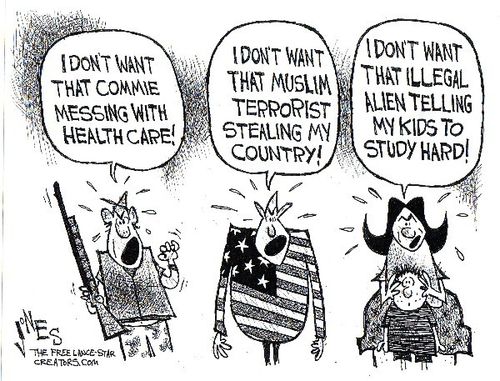
The inability to confront this issue comes from a myopic laziness that has grown from easy and fast midterm election gains.  The divide-and-conquer midterm election strategy has morphed into its own beast in today’s hyper-politicized environment, and the intoxicating effect of winning has paralyzed today’s hopeful candidates. The GOP have become masters at understanding that the key to midterm gains is to not confront national issues or win votes from the 1-2% of undecided voters as with a general election, but to energize their hard-core base. You don’t do this with policy, problem-solving, or congressional effectiveness. You do this with emotion and division. They are the problem (poor, immigrants, gays), and we are the solution (job creators, guns, evangelicals).That’s the message; stay on it and reap the rewards. The more divisive language you can spread through the base, the better chance of getting that base to vote in a mid-term election.


cartoon commie health care.jpg


The problem is that no one has told these 20-some-odd current GOP candidates that this strategy will not work in today’s national election for one simple reason: more people vote. And yet, Mike Huckabee is banking on the strategy so heavily that he’s written an entire book about the differences of the “bubbas--" good ole rural white folks who form the backbone of this country--and the “bubbles--" the liberal, tree-huggin', artsy, welfare-sucking city slickers who are bringing this country down. Now just imagine for a brief second the candidates coming down the home-stretch of the national election and one of them campaigning with that message. (Some will argue that his entire campaign is just a publicity stunt to further his public persona career. I’ve yet to see any sign that he is anything but genuinely convinced this strategy could work.)  


Huckabee serves as a caricature of what the party has devolved to, as his divisiveness is more Hee-Haw-silly than hateful. But the eventual nominee will have to rise above that divisiveness and recognize that winning a national election will have to involve some type of unifying message, which becomes another problem for Republicans.


As a country, we are tired of war, and we are tired of all the economic gains going to the 1%. We are tired of the constant hate for poor people, minorities, immigrants, gay people, and women’s rights. We are tired of the wedge issues, such as abortion. We finally see through the masquerade of trickle-down economics. We see the crumbling infrastructure with no desire to fund it. Gun rights only go so far, and for that matter, we’re tired of the NRA running Congress. So tell me: what will be the rational, reality-based, unifying GOP message that will bring in the undecideds and independents?

They are running out of options, they are running out of viable candidates, and they are running out of core-base voters. If voter turnout stays at the historic low levels of the recent midterms, then it could be close. If the Dems can create another participation-is-hip vibe, as Obama did in ‘08, it won’t be. 

There is a good possibility that we’ve entered a long-term stalemate of GOP state and local control and democratic presidential control. Of course, this is more or less how our government was created to exist--with balancing forces. But the political forefathers did not envision a time when our leaders refused to confront and solve national problems. If you inject enough greed, toxicity, and power-grabbing, even democracy has its limits.

--Brian Paul Swenk


If you like the posts, please share and sign up for emails on the left.


Keep up with me here:
Twitter

Thursday, May 7, 2015

Why the Ferguson and Baltimore riots are different than every other riot in history


Have you noticed that the recent riots in Baltimore and Ferguson seem different than every other riot we learned about in school or see in the movies? Have you taken a moment to wonder why this is? Well, try this: find an uprising by the poor against an establishment that’s either over 150 years old or in a fictional narrative (Hunger Games, Star Wars, The Matrix, etc?) and take notice of who you identify with. Take notice of who you cheer for and who you empathize with. Take notice of where your sense of respect lands for the bravery and sacrifice of the oppressed. Is there one single populist uprising, historical or fictional, that you honestly side with the establishment?

Our nationalistic narrative teaches us from an early age that our freedom came from rising up against establishment powers. Our country was built on it. It’s ingrained in us to view history through the lens of the underdog, the oppressed, the poor, and the marginalized on a truly consistent basis. It is so natural that we don’t even notice it. But as we watch what is happening in our own country--in Ferguson and Baltimore--we have a completely different and visceral reaction: these riots are different. These riots are not the same as every other riot we’ve ever learned about. These riots are perpetrated by thugs who have no justified reason for violence and destruction. All the other riots had a purpose, but not these, no way.

So here’s the big question: if this turns into a flashpoint of American history, and the riots continue and alter our society in a historically noticeable way, how will the people view them in 200 years? Will they see them with our perspective? Or will they view them the exact same way we view the uprisings of 200, 300, 400 years ago?

The uncomfortable truth that we all need to face is the only thing different here is our perspective. These are the only riots out of the historical thousands that are different because they are against us. The truth is that we are the establishment here. We work in the establishment, we vacation in it, and we buy houses, cars, trucks, boats and motorcycles in it. We put our kids into it and trust it to take care of our elders. We tell ourselves that we are individual and unique and that this very individualism and uniqueness will allow us to thrive inside this establishment. We all want to be special, but how can we be special if we don’t have an establishment to recognize it?

As we see good, honest people invoke the words of Dr. King over a CVS store being burned but not for the constant reports of unarmed black kids being killed, we have to recognize and admit that we identify more with the CVS store than the dead kids. That attack on the CVS store, which played in endless loops on cable news, is us! We are that CVS store. These riots are different because they are attacking us. Our invocation of the words of Dr. King and Ghandi over a CVS store, but not kids being killed, shows us everything we need to know about how history will view this.  

As we live in, invest in, and build our establishment that has a consistent historical record of standardized violence against poor minorities, we can’t stand back and be shocked, with any type of intellectual honesty, that we receive it back. We, at the very least, have to admit that we hold a strong double standard when it comes to violence. We celebrate and make a hero out of the black mom who beats the shit out of her kid on national TV, but we would be appalled if it happened in a rich, white suburb.

“Over the past four years, more than 100 people [in Baltimore] have won court judgments or settlements related to allegations of brutality and civil rights violations. Victims include a 15-year-old boy riding a dirt bike, a 26-year-old pregnant accountant who had witnessed a beating, a 50-year-old woman selling church raffle tickets, a 65-year-old church deacon rolling a cigarette, and an 87-year-old grandmother aiding her wounded grandson.

“The money paid out ($5.7 Million) by the city to cover for the brutal acts of its police department would be enough to build a state-of-the-art rec center or renovations at more than 30 playgrounds. Instead, the money was used to cover for the brutal acts of the city's police department and ensure they remained well beyond any semblance of justice.”  -- Ta-Nehisi Coates quoting the Baltimore Sun report: Undue Force


I get the sense that a lot of us just don’t understand what true marginalization means (or the difference between “understanding” and “condoning” events, for that matter). We just can’t understand why these people don’t work, don’t get an education, don’t....just be rich. We can understand marginalization within the historical sense, or in the Hunger Games, but not in today’s world. Because understanding it in today’s world means that something might be wrong. And admitting something could be wrong might, just might, alter the social power structure that deep down we all worship and obey. Who among us wants that?

John Oliver on the realities of marginalization in Ferguson


--Brian Paul Swenk

If you like the posts, please share and sign up for emails on the left.

Keep up with me here:
Facebook
Twitter

Tuesday, March 31, 2015

A *no spoiler* review of The Walking Dead and why it is so successful.


The following review does not have any spoilers.

You can make the argument that we are currently in the golden age of television or you can argue that we are in the second golden age of television; either way, there's no denying that the best writers of our time have migrated towards the medium.

Today's television is punctuated with emotionally complex characters who engage in masterful dialogue about current, meaningful topics or the great mysteries of life and consciousness...and The Walking Dead is not one of those shows.


This season is my first experience with this show, and as the season finale came to a close last night, it got me wondering why this show is so deservingly successful in a landscape of emotional heavy-weight television. As I've grown older, I've realized that I enjoy writing of any medium that brings deeper insight and understanding of either pertinent, topical issues or the universal human experience. Whether it's the complexities and reality of the dark side of human nature, as in True Detective, or the hyper-dramatized reality of cutthroat, power-hungry politics of House of Cards, I feel as I have a rather high expectation of what I will dedicate my time to. Which is why I've been pleasantly surprised with my full engagement and enjoyment of The Walking Dead. 

The reason TWD is so successful, I think, is because it generally has a very clear sense of self-awareness. It is a show about survival, but more importantly the creators know it is a show about survival. That might sound simplistic, but if there's a lesson that you learn with age and experience in art is to know yourself, know what you can do, and then do it well. This show knows that surviving in the world which it created is supposed to be basic and simplistic. They dig into the deepness of the first basic human instinct and are able to find the rich complexity of survival instead of manufacturing it through esoteric, philosophical writing and over-dramatic acting. And for that, I'm impressed.

Andrew Lincoln as Rick Grimes
The two main criticisms you'll hear about this show are about weak writing and weak acting, namely from the Rick and Daryl characters. These criticisms, in a general sense, are not off base, but I will argue that it is a situation where an obvious weakness has, fortunately, turned into a strength. Great stories are great because they not only sell you on the premise, but they bring you into the story. They allow you to become invested with both the heart and the mind, into whatever world they create. In short, they have the power to make the unbelievable believable. There's a raw honesty to TWD and I think it has a lot to do with the simple, primal drive of characters such as Rick and Daryl. They are not characters that are emotionally reactive and they do not require consistent emotional transformations, because that's not the type of person that will survive the impossible odds that the story creates. Deep down, we, as an audience, either consciously or subconsciously connect with this group of people who are not Hollywood pretty or Hollywood emotional. Instead, they remind us of us, or at least what we would like to be if we faced a world of zombies. There's a realness there that not only sells the story, but takes us down the road with them.
Norman Reedus as Daryl Dixon
 The Talking Dead
TWD, as I said earlier, has a massive fan base, which is not uncommon;  the difference is this fan base is completely engaged with this show on a level that makes other shows envious. There is a live show, The Talking Dead, that follows every episode. Actors discuss the current episode and it features real-time tweets, Skyped questions from fans, and quiz contests. Name another show that has that! This show is successful not because it is trying to match complicated, poignant dramas note for note, but because it knows what it is and what it can bring. It is the John Hartford of bluegrass. It is the ZZ Top of rock. It is the Stephen King of prose. The Walking Dead has its own personality and drive, and it taps into our primal desire for survival, which in the end, really is a big question of life.


--Brian Paul Swenk

If you like the posts, please share and sign up for emails on the left.

Keep up with me here:
Facebook
Twitter