Wednesday, February 24, 2016

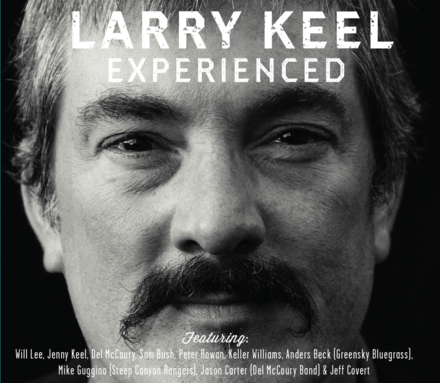
Larry Keel--Experienced.

Few people can get away with describing their music as an “experience.” But then again, few words come close to actually describing the music of Larry Keel. To see Larry Keel perform is to have just that: a unique, singular experience that cannot be duplicated.   


On February 26th, Larry Keel will release his 15th self-produced album, aptly titled Experienced. This album is a portrait of an artist coming full circle into his unique style and voice, but this time embracing it with a deeper sense of comfort and wisdom.  


Experienced is a guest-filled album, featuring some of the biggest names in bluegrass and Americana on 5 of its 7 tracks, including Sam Bush, Del McCoury, Jason Carter, Peter Rowan, Keller Williams, Mike Guggino of Steep Canyon Rangers, and Anders Beck of Greensky Bluegrass. But the songwriting and playing from Larry, Jenny Keel (bass), and Will Lee (banjo) are so strong that it never feels like a guest album. The guests each give their respective tracks a sense of color, but even with the blazing fiddle of Bush in the album’s opening instrumental “Ripcord,”  there is never a moment where you forget this is Larry’s music.


Even with the aforementioned star-power featured on Experienced, the album MVP is undoubtedly banjoist Will Lee. Larry and Will played in the cutting edge newgrass band McGraw Gap from 1990-1996 and were winners of the prestigious Telluride band competition in 1995.
larry.png


Experienced starts out with the Lee-penned instrumental “Ripcord” that builds a sonic tension throughout the first half of the song and then allows each instrument to release a flurry of hard-driving bluegrass runs that take off with drag-racing intensity. Most artists wouldn’t pick an instrumental to open their album, but most artists don’t have the ability to bring so much joy out of their instruments as Larry Keel, Will Lee, and Sam Bush.  


The second track, “Lil Miss,” quickly reminds you who’s in charge, as Larry’s distinctive voice hits you like a California mudslide. This track is vintage Larry Keel as the trio uses harmonies, punchy rhythms, and solos that alternate between laid back and chaotic.   


There are two defining tracks for this project. The first is “Miles and Miles,” which features Larry’s soul-brother Keller Williams. The song was the title track of Larry’s 1997 release, but it takes on deeper meaning today. I mentioned to Keel that the song feels like a younger version of himself wrote a letter to the man he is today. “It does feel like that,” says Larry. “The song is the story of a traveler’s life, and knowing how much Keller Williams and I have traveled in the 20-plus years we have known each other, it seemed only fitting. Full circle, I reckon!”


The second defining song is “The Warrior,” which is written from the viewpoint of a Native American warrior and perfectly features the haunting, legendary howls of Peter Rowan. The Warrior is a seeker of truth and knowledge, a man that isn’t afraid to walk this world in search for something greater and more meaningful than himself. It is easy to see Larry Keel as this warrior, as he has spent his career following the spirit of his own unique sound.  


“Fill ‘Em Up Again” is fun bluegrass romp by Will Lee that features Del McCoury, Jason Carter, and Mike Guggino that reminds us that this band comes from the world of bluegrass music and can play it as well as anybody out there.      


Larry is a unique artist in that he never settled as just being a guitar wizard, as so many young virtuosos do, but instead, he created his musical identity through his own personal vision. Many artists are capable of one or the other, but few accomplish both. Experienced is not just a celebration of this accomplishment but also a retrospective embrace of it. We hear many original and unique voices in this industry, but rarely do we encounter one so incredibly genuine.   


In “Miles and Miles,” Larry sings, “My truthful heart will light the darkened path.”


It would be hard to find anyone singing a line more honest than that.


Keep up with The Larry Keel Experience:
www.larrykeel.com
www.twitter.com/LarryKeel

--Brian Paul Swenk

Keep up with me here:

If you like the posts, please share and sign up for emails on the left.

Monday, January 11, 2016

The Life of David Bowie: A Rebel's Rebel

Of all the tributes appearing about David Bowie, no other will extract the essence of rock-and-roll for the disaffected and oppressed more than Mazlar Bahari has here.

"For so many of us who grew up in the Islamic Republic of Iran in the 1980s, David Bowie was an inspiration and a refuge from a claustrophobic environment. At a time when you could be lashed or go to jail for owning an audio cassette of western music, we would search all over Tehran for a Bowie album. We listened to anything we could find, from Space Oddity to Young Americans, over and over again. We watched The Man Who Fell to Earth a dozen times without understanding the plot or dialogue. We begged our friends and relatives in the West to send us his latest albums and the most recent books about him.

I will never forget the sadistic school principal who confiscated my David Bowie book, insulting and slapping me around for bringing a book about a cross dresser who kissed other men to school. "Do you want to be a faggot like him!? Don't you know we kill the fags in Iran?" he said as he tore the book into pieces, throwing the shreds in my face. "Should I send you to the Revolutionary Guards and tell them you're a fag!? Do you want to know what they will do to you!?"

I was trembling with fear. It was 1983, and many innocent people had died by the hands of the regime for crimes less than having a picture of Bowie and Lou Reed kissing each other. My only solace was reciting the words of Five Years, which I used to listen to every morning.

Pushing through the market square
So many mothers sighing
News had just come over,
We had five years left to cry in


In those dark days of 1980s Iran, rock music was a glimmer of hope for many of us. David Bowie represented many different identities and personas in the West, but to us in Iran he was a cry against indoctrination and the prejudices that surrounded us. He was among one of our saviors. He transcended music, film and fashion. Things that define our identities and make us human.

David Bowie never dies." --Mazlar Bahari

Bowie would never be placed high on a list of influential musicians throughout the south as he pushed the limits of artistic expression way past the comfort level of bible-belt sensibility. In spite of that--or actually because of that--it's worth some time to look back at his life and his art and how he merged the two so easily and successfully.   

Most Americans know David Bowie for two things; the Ziggy Stardust character and the song Let's Dance. But in fact he was a prodigious writer who's constant need for creative expression was both his strength and weakness. A young David Bowie first wanted to blend his two favorite things, rock and roll and musicals, into a singular concept, believing it to be the next artistic evolutionary step for rock music. If there were three steps from conceptualization to realization on this grand project he achieved two of them; the artistic concept and the music that came out as The Rise and Fall of Ziggy Stardust and the Spiders from Mars. The final step of creating the theatrical play was never taken. He had already moved on to other ideas and couldn't stand the thought of continuing as the character Ziggy Stardust. This constant movement left us with multitudes of material by Bowie, some of which never fully realized. 


You've got your mother in a whirl
She's not sure if you're a boy or a girl
Hey babe, your hair's alright
Hey babe, let's go out tonight
You like me, and I like it all
We like dancing and we look divine
You love bands when they're playing hard
You want more and you want it fast
They put you down, they say I'm wrong
You tacky thing, you put them on

--Rebel Rebel

The phrase "ahead of his time" is so overused that it has all but lost any meaning. But for this moment in time, as we reflect on the life of David Bowie, we see a person that deserves the label. Bowie was a rebel's rebel. When the counterculture was the blue-jean and t-shirt wearing all-natural hippy, Bowie was playing five moves ahead. "We were creating the 21st century in 1971," said Bowie to Terry Gross on NPR.

Bowie foresaw more than just artistic trends throughout his life. He correctly predicted the downfall of recorded music revenues as we moved towards the digital streaming age, and attempted to stay ahead of the collapse with off-the-wall ideas such as selling "Bowie Bonds." It was 1997.

"You'd better be prepared for doing a lot of touring because that's really the only unique situation that's going to be left," Bowie said. "It's terribly exciting. But on the other hand it doesn't matter if you think it's exciting or not; it's what's going to happen."

There's a starman waiting in the sky
He'd like to come and meet us
But he thinks he'd blow our minds
There's a starman waiting in the sky
He's told us not to blow it
'Cause he knows it's all worthwhile
He told me
Let the children lose it
Let the children use it
Let all the children boogie

--Starman

Combining post-modernism with artistic hyperactivity, Bowie and his cohorts lived the philosophy of "Everything is rubbish, and rubbish is beautiful." If only everyone's rubbish could be anywhere near as beautiful. Thanks for staying five moves ahead Mr Bowie.   

The first music video ever produced in space was of course a David Bowie song. 


--Brian Paul Swenk

Keep up with me here:

If you like the posts, please share and sign up for emails on the left.

Wednesday, December 2, 2015

My favorite things: Christmas gift ideas for people who love music, traveling, and reading

This may seem like a random post, I realize, but after a couple of people asked me about a few of these things, I decided it might be a good topic.

Here's my rule of thumb: When it comes to prescription meds, buy generic. The extra money for name brands is a rip-off. But when it comes to travel and music, the extra money spent on quality can be a huge difference. Many of the things listed here are recommended because I've tried the cheap Walmart knockoffs first and then looked for something better. Normally I am always looking for the cheaper option, whether it is generic or used, but here, with this list, I've found things that are worth their price and more.

This list can work for anyone that is into travel, reading, music, or the outdoors.

Music:

Bose Mini SoundLink
A friend of mine went to a dinner party and heard this speaker, and he immediately bought it when he got home. I went to his house and heard the speaker and I came home and also immediately bought it.....and so it goes, on and on.  There isn't a better sales pitch than that. The sound is that impressive and I haven't talked to anyone who said it isn't completely worth the $200 price tag. It is completely wireless with a built-in rechargeable battery and Bluetooth capability.

Beats Wireless Headphones
I predict this will be one of the "it" things this year, especially with rumors swirling about the possibility of Apple dropping the headphone jack for the iPhone 7. I seriously doubt this particular rumor is true, but as with all things, there will be a time when headphones will be predominately wireless.  And you might not think that losing that tiny wire between the headphones and the device in your pocket is a big deal, but after trying them for a few minutes in the Apple store, I can say that it actually is.
Dead and Company CDs
If you have a Deadhead in the family and have more time than money, you can download the recent Dead and Company shows and put them onto blank CDs.  The steps are easy:  Download the VBR MP3 files from each show here: https://archive.org/details/DeadAndCompany
Unzip the folders
"Add to iTunes library" and select the unzipped files
Burn the shows onto individual discs.

I haven't seen Deadheads this excited about a lineup in the last 20 years.

Travel and the Outdoors:

Stanley vacuum-sealed travel mug
I've used my fair share of cheap Walmart $9 travel mugs through the years, and can say this one is worth every single penny. It's completely leak proof and will keep your coffee hot through the majority of the day. The inside is metal and therefore BPA free.


Another option that is slightly smaller with more appealing colors (I bought this one for Amanda and she uses every single day) is the Camelbak travel mug. It's also vacuum sealed and will keep coffee hot for the majority of the day.

Salomon Quest 4D 2 GTX Hiking boots
I bought these boots a few years ago, and halfway through my first hike I decided I would not buy anything else ever again (as long as they're available). And if my opinion isn't enough, the Navy Seal who wrote No Easy Day, about the mission to get bin Laden, mentioned these exact boots as his go-to choice for operations in the Middle East--so there's that.


Hydro Flask Water Bottle
I've used almost every water bottle you can get your hands on, and nothing beats this one for daily use. The only time it might not be optimal is for long-distance thru-hikes where every ounce is considered--it is heavier than most. Otherwise, it works exactly like the vacuum-sealed coffee mugs above. You can fill it up with water, put 3-4 ice cubes in it, and your water will be cold for days. You'll be asking yourself "What black magic is being used here?!" These are also stainless steel and BPA free. Hydro Flask also makes a travel coffee mug and now has an insulated pint glass.


Born boots -- Allen style
If you're the type of person that can't stand the idea of having "dress shoes" that aren't able to stomp around in a wet, muddy field, check these out.  They are more "dress" than "boot" though, so don't expect to step in ankle-deep water and stay dry-- tried that one a couple weeks ago.

Kershaw Pocket Knives
Kershaw makes great, affordable knives of all types, colors, and sizes. If you buy one of these for your guy and he doesn't love it, then just leave. Yes, it's that simple.


Reading--for the nerds of the family:

I think subscriptions to high-quality media publications are a great gift idea if chosen correctly. Of course, you run the risk of unread magazines piling up on a coffee table all year, but I think we are all craving perspective and a deeper knowledge of what's going on in the country and the world. Social media can be nothing but empty calories of knowledge--we see it daily. But to break free of the "addiction of distraction", as Tony Schwartz wrote about for the NYT last week, and read something that took effort, research, travel, interviews, knowledge, and deep perspective becomes very enjoyable--like a home-cooked meal after living off the McDonalds dollar menu for 3 straight weeks.
I recommend the following:

Rolling Stone--Yes, you have to wade through the occasional profile of Britney Spears, but the long-form journalism of Matt Taibbi blowing the lid off the collusion of the Wall Street banks and the federal government is well worth it. It's also how I keep up with the various parts of the music industry without having to actually listen to the music.

Outside Magazine-- I first subscribed to this one years ago for tips on trails, gear, and biking, and then I found that it holds some of the best, most captivating writing I've found anywhere....period. It's no secret that great writers seek adventure first. It's a perfect match.

The Atavist Magazine-- This is a digital-only publication featuring the best long-form journalism in the world. The stories are both true and fascinating and read like great short stories. The cost is $24/year, and from what I can tell, it's well worth it.

The Atlantic-- No one is doing current events better than The Atlantic.

I can't believe I just spent two hours making a list of my favorite things...but there you have it. There are many types of "great gifts," but finding something that a person will use on a daily or weekly basis for years is a home run in my book. I hope this helps.


--Brian Paul Swenk

Keep up with me here:


If you like the posts, please share and sign up for emails on the left.

Saturday, November 21, 2015

The Success of John Mayer with Dead and Company


Fare you well, Fare you well
I love you more than words can tell
Listen to the river sing sweet songs
To rock my soul
--Robert Hunter, Jerry Garcia


As we stood in the upper half of Madison Square Garden last Saturday and listened to Bob Weir and pop-star-turned-deadhead, John Mayer, sing those words in the newly formed Dead and Company, a realization came over me about the power of the Grateful Dead’s music. The initial attraction, staying-power, and cult-like following of the Grateful Dead comes from Jerry Garcia’s ability to transcend both personal and musical ego and allow the music to grow out of genuine emotional sentiment. In those special moments of “Morning Dew,” “Stella Blue,” “Wharf Rat,” or a dozen others, Garcia’s voice becomes so plaintively raw and pleading that you feel as though you’re not only seeing through the public mask that adorns us all, but into the heart of a man yearning to find freedom and redemption through public musical confession. So much of today’s popular American music comes not from real people, but from the carefully crafted characters they play on and off stage; yet Garcia and the Grateful Dead became one of the most successful bands in the world by peeling away those false layers year after year in front of thousands of fans, until there was little left other than the song...and maybe a drug addiction or two.    


There used to be a time when art, literature, and music could be openly based around sentiment. A person’s raw emotion had the power and legitimacy to drive a song or a story. Now, with our every waking minute being consumed by the hyper-industrialized process of profit driven media commercialism, sentiment has fallen out of favor, replaced by the protective mental armor of Irony and Cynicism. The Millennial-driven multimedia world thrives on an outward display of attitude and hipness. Any notion of inwardness or sentiment is seen as weakness by naivete. Author David Foster Wallace wrote, “What passes for hip cynical transcendence of sentiment is really some kind of fear of being really human, since to be really human is probably to be unavoidably sentimental and naïve and goo-prone and generally pathetic.”

Photo by Katie Friesema


The Dead and Company consists of original members Bob Weir, Mickey Hart, and Bill Kreutzmann, along with Allman Brothers bassist Oteil Burbridge, pianist Jeff Chimenti, and pop-star John Mayer on guitar--essentially playing the sacred parts of Jerry Garcia. The genuine confusion as to why three of the remaining members would tour with John Mayer has suddenly been replaced with questioning why is this the most successful incarnation of the remaining members in the last 20 years. To attempt to answer this “why,” you have to be willing to dig deep into our complicated and mysterious relationships with music, art, popular culture, expectations, and biases. It is almost the perfect storm for music lovers to confront why and how we love music and how much power it has in our identities.


When Bob Weir announced they would be doing a major tour with Mayer on guitar, there wasn’t any of the emotional backlash that occurred with Phish guitarist Trey Anastasio playing the final Chicago shows in July. (Those were the final shows that included all four living members of the GD; original bassist Phil Lesh has bowed out of any further tours.) Instead of the passionate and heated online debates, fans seemed to react to the announcement with a mix of shock, disappointment, and a collective eye roll. The band and music they had dedicated so much of their lives to was going to tour with a guy who had spent years as celebrity tabloid fodder. But when the first shows happened and people listened to the recordings, everything changed. There was a passion and buoyancy in the music that had not been heard since the 70s and 80s.


After attending one show and listening to a half dozen others, I believe that Mayer’s success is based around his natural inclination to find and share the deep emotional content that Garcia brought to the music. His ability to soulfully connect to the music of the GD is also, ironically, the same quality that made him famous in the female pre-teen pop world by writing songs such as “Dreaming with a Broken Heart,” “Slow Dancing in a Burning Room,” “Daughters,” and “I Don’t Trust Myself with Loving You.” The only sin greater than expressing sentiment is doing it for pop-culture fame. Our mental armor of cynicism creates a distrust of anything that is both popular and sentimental. It can be one, but it can’t be both--or so we tell ourselves.  

Photo by Tim Johnson
In the 20 years since Garcia’s death, the remaining members have formed many incarnations with the who’s who of rock guitarists: Warren Haynes, Jimmy Herring, John Kadlecik, Trey Anastasio, and Derek Trucks. I will argue, however, that Mayer is the most successful by a long shot. There is something within Mayer that allows him to wear the heavy cloak of the legacy of the GD while not losing his own personality. It’s the unique mix of tradition and youthful energy that makes the spirit of the music sound more alive than any other time in the last two decades. He plays with the technicality of Trey and Jimmy, the soul of Warren, and the creativity of Trucks. Most importantly, he also plays with the same deep musical sentiment that made us all fall in love with Jerry Garcia in the first place.


--Brian Paul Swenk

Keep up with me here:


If you like the posts, please share and sign up for emails on the left.

Tuesday, November 17, 2015

We tell ourselves "Love Wins" after the Paris attacks. I wish it would.


26 state governors are refusing to help the refugees. Their excuse is the Paris attacks, but that's bullshit. They were determined to hate those refugees no matter what happened.

Those refugees are guilty of the three worst sins in the eyes of many:

1. Poor
2. Need Help
3. Have Dark Skin

As a nation that worships wealth we confuse money for virtue.

It's why a poor hispanic kid will do more jail time for a bag of weed than any Wall St exec will do for defrauding their customers and crashing the world economy.

It's why if a poor black kid is killed by a cop we say "He must have done something wrong"

It's why we vote for tax breaks for the rich before pay raises for our teachers.

If you're poor, no misdeed should go unpunished. No racist fear should go unchecked. The God Of Wealth has not shown you blessing therefore you're devoid of virtue, and we are content with our Christian (in name only) judgment upon you.

If you're rich, you've been blessed by the God of Wealth, will be bestowed with the obvious holy name of job "creator" and any transgressions in the name of wealth accumulation will be instantly forgiven.

We're a nation of immigrants that claims to worship a poor middle eastern family with a newborn child that needed help one Dec night. But 26 elected state governors would turn that family away saying "Well, they were poor and probably terrorists"

The terrorists hate those refugees as much as they hate the western world. If every nation closes its borders and lets them starve and suffer then we're doing exactly what the terrorists want--just becoming pawns in their strategy and letting barbarians outsmart us.

Moments after an attack we tell ourselves love will overcome, but we only need a couple days to realize that fear, nationalism, and callousness are our defining traits--ironically, the same traits that make the terrorists evil in our eyes. Let that sink in.

The fact of the matter is that we are not worried about American deaths, we have mass shootings on a daily basis with no desire to change it. But we are worried about angering our God of Wealth by allowing poor, dark skinned people to have something they "didn't earn and don't deserve." Be it food, shelter, or even a tiny sense of safety after they've left their entire lives behind as their country burns to the ground.

We tell ourselves "love wins." I wish it would.


--Brian Paul Swenk

Keep up with me here:
Facebook
Twitter

If you like the posts, please share and sign up for emails on the left.

Tuesday, November 10, 2015

A 67 year old woman defends herself from a man with a cigarette

The story below comes from Jim Wright's page. Wright is a freelance writer that lives in Alaska, and writes about contemporary issues and politics with a unique combination of intellectual prowess and bravado.
This story is a perfect example of where my long-standing belief in gun rights starts shading into common sense and practicality.
When presidential candidate Bernie Sanders was questioned on his gun-rights voting record, which seemed more in line with the GOP than the Dems, he explained that he was from a rural state where guns were a way of life, used safely, and did not require the same solutions as urban areas with high crime rates.

Most all of us who grew up in Sparta, NC can empathize with his feelings on the matter. You were much more likely to be hurt or killed in a car or tractor accident than with a gun, even though nearly every house had one. The idea of gun restrictions didn't make sense and aroused the hyper-active fears of totalitarianism.

But that doesn't do anything to solve the problem of our outrageously high rate of daily gun deaths. Or the fact that a gun in the house has a higher probability of killing someone in the house than an intruder.


I've always been pro-gun because of my hometown experience, and I've always tried to be pro-common sense and pro-keep-people-alive. It's becoming harder and harder to simultaneously hold those views lately.

Without further ado, here's the story of a 67 year old lady defending herself with her gun and guy who almost died over a cigarette.

______________________________

Today's Good Gal With A Gun moment


A man bought a pack of cigarettes in a Murfreesboro, Tennessee, Walmart. He was walking through the crowded parking lot and realized he didn't have a light, so he asked a convenient person - you know, like you do.


That person, 67-year old Sherry McLain, pulled out her gun and threatened to shoot the man dead on the spot.


The man, as you might expect, was somewhat taken aback. In fact, he was terrified, he turned and ran back towards the store. McLain tracked him with her revolver, sweeping numerous other patrons with her muzzle including a 7-year old boy, his mother, and his grandmother who were nearby.


The man ran inside the store and called police.


The police arrived, took the man's statement, looked at the security video which corroborated his story and showed he'd approached the woman no closer than ten feet, talked to witnesses including the woman and her son who'd been swept by McLain's weapon, and arrested Sherry McLain for aggravated assault and reckless endangerment.


McLain is outraged.


"It scared me absolutely to death," said Sherry McLain. "I have never been so afraid of anything in my whole life I don't think. This guy is the bad guy and I'm the one in handcuffs walking away."


I have never been so afraid of anything in my life.


A man asked her a question and she's never been so afraid in her life.


This guy is the bad guy, see? Because that's the world these ammosexuals live in, the one where it's the BAD guy who calls the police, and GOOD guys are the ones who menace others with a deadly weapon in a public parking lot.


"What are we supposed to do if we can't protect ourselves. I'm 67 years old," said McLain.


What has America come to when you can't defend yourself with deadly force from an unarmed, non-threatening guy who asks you for a light? My God, people! What has America come to when you can't just brandish a loaded weapon and endanger others in a public place? Oh the oppression! Oh the tyranny!


I know the Surgeon General says smoking is bad for your health but being executed over it might be taking things a bit too far.


Ask yourself this: What if there were no security cameras to back up this guy's story? Or the cameras weren't good enough to see what was happening? What if there were no witnesses? What if she was all respectable looking and he was disruptable in appearance. What if she was white and he was black? Latino? Some immigrant with a funny accent and a turban? What if this was Florida?


And what if she'd shot this poor bastard down, since she'd never been so afraid in her life?


Without witnesses, without the cameras, without the victim's word, she'd very likely get away with murder.


She would, in point of fact, have been a hero.


Yes indeed, she would have been a big damned hero.


She would have BELIEVED herself a hero, a shining example of the Second Amendment, a good gal with a gun defending truth, justice, and the American way.


--Brian Paul Swenk

Keep up with me here:

If you like the posts, please share and sign up for emails on the left.

Tuesday, November 3, 2015

My Case for Supporting the Candidacy of Donald Trump

Donald Trump’s candidacy is shaking the foundations of American plutocracy-- why we should cheer him on.


Most of us think Donald Trump’s campaign is the low point for both American politics and American society. And sure, the racism, xenophobia, misogyny, and narcissistic reality show attention tactics do, in many ways, show Americans at our worst. But if you step back, place it in a historical context, and disassociate yourself from Trump representing the worst of us to the world, you can begin to see his candidacy as what we both need and deserve at this moment in time. From there, you can almost begin rooting for Trump, not because you agree with anything he says or think he’ll be a good president, but because watching him shake the plutocratic foundations of our ineffectual government is worth the risk.   


From Watergate to the impeachment of Clinton, and from George “Dubya” to Obama, we’ve slowly lost any idea of what a functioning government should do: move money around to solve societal problems and protect us from foreign invaders. The slow involution of American politics has left us with extremists and demagogues, who, by mandate of their equally extremist constituents, are sent to Washington to hijack the political process through any means necessary. By blocking any effectiveness of the federal government, groups such as the 40 member House Freedom Caucus thereby affirm their worldview that federal government is, in fact, ineffective.   


From the paralyzation of the federal government to the facade of the never-ending campaign spectacle that gives the illusion of choice and issues, Donald Trump’s political sledgehammer is breaking down walls and allowing a new light to enter. At this point, breaking through the carefully crafted political “reality” that is presented to us by the establishment of Republicans and Democrats will not be painless. This political facade was created not just for overall public control, but to allow us to remain ignorantly blissful of the dirty, corrupt, and, if we’re to be honest, racist motivations of institutional power.


Exposing inherent racism and nationalism is not a novel concept. But creating a space for it to be gregariously expressed, as Trump has, has not happened since the 1968 and 1972 presidential campaigns of segregationist George Wallace (respects paid to Pat Buchanan, of course). While remnants of Wallace-style outward racism remained steadfast throughout the southern United States, the country, as a whole, told itself it had moved into a “post-racial” reality. Through the 80s and 90s, we believed our inherent goodness transformed outward racism into the anodyne process of fiddling with government diversity statistics in the name of “affirmative action.” Or that we somehow grew into dealing with broader issues such as the drug and crime epidemic. We even reaffirmed our post-racial status with popular entertainment such as The Cosby Show--if African-Americans didn’t want to work their way up to upper-middle class comfort, then it was their own fault.    


What seemed to be enlightened growth on the outside was anything but that on the inside. After Lyndon Johnson signed the Civil Rights Act of 1964, the southern segregationists, who were mostly Democratic, dissociated themselves from the party. In one of the smarter political moves of the century, Nixon made a backroom deal with Strom Thurmond at the Miami GOP convention in 1968 to fold them into the Republican party, thereby guaranteeing him the presidency. “It took two election cycles to convert the ‘Solid South,’” wrote William Greider on the event,” but Nixon and GOP apparatchiks made it clear with private assurances that Republicans would discreetly retire their historic commitment to civil rights.”


While as a nation we were celebrating mass-marketing campaigns of the 1980s that felt hip and inclusive, the southern segregationists moved to the back rooms of government and focused not on simply repealing the Civil Rights Act, but on slowly dismantling it piece by piece under the euphemism of “states’ rights.” Community law enforcement practices aside, the federally mandated mandatory minimums under Clinton, our so-called “first black president,” (further affirmation of “post-racial”) produced the blatantly racist mass-incarceration epidemic. And one only has to look back a few months to the sustained GOP-lead attacks on the Planned Parenthood funding to find current whittlings of any type of assistance to the poor, predominately black communities. It is no secret that Planned Parenthood is directly responsible for abortion rates being so low today--free birth control works! But the real ire of today’s white nationalists is the idea that poor black women might be getting taxpayer-funded medical assistance they “did not earn.” The false notion that PP is “selling baby parts” is the perfect bait and switch to further reduce funding for people in our poorest communities.


Trump has done much more than root out the remaining segregationists, now referred to as “nationalists,” with his anti-immigration rhetoric. He’s also been the wedge to crack open the growing schism between the rural Southern conservatives and the corporate elites who’ve always controlled the Republican party and solely benefited from their anti-tax, anti-regulation platform. This populist disillusionment and anger, which started slowly with the tea-party libertarians from the Bush Wall Street bailout years and quickly gained momentum with the election of Obama, has now taken hold as the socially conservative faithful have realized they’ve been sold up the river, so to speak, by Republican candidates who promised social conservatism but instead delivered corporate plutocracy. The answer to the decades old question of “Why do poor, rural whites consistently vote against their predominant and obvious financial interests?” is not only being exposed but is starting to unravel. Again, Greider writes about speaking with Democrat and staff director of the House Appropriations Committee, Scott Lilly: “‘The problem,’ Lilly said, ‘is that this latter group has almost nothing in common with the country club wing.… The country clubbers don’t care about prayer in the public schools, gun rights, stopping birth control, abortion and immigration.’ On the other hand, common folks don’t worry over marginal tax rates, capital formation, or subsidies for major corporations. ‘If they ever fully understood that their more prosperous party brethren were contemplating deep cuts in Medicare and Medicaid to pay for those policies, they would be in open rebellion,’ said Lilly”


It’s hard to imagine Trump not being conscious of the implications of every move he makes. But one has to wonder if he fully grasps the electoral outcomes if he continues to split these social conservatives from their country-clubbing bedmates. At the worst, these disenfranchised voters will primary moderate republicans with candidates willing to bring the federal government to its knees, such as the suddenly infamous House Freedom Caucus. But with an admittedly unfounded sense of optimism, we can hope that many in the Republican base will start voting for their own middle-class economic interests. As we’ve seen in this rather fascinating race for 2016, populism works both ways, as does freedom of speech, and by rooting out the hidden racist motivations of the backroom Republican establishment, Trump’s candidacy is showing us who we really are. If we have any chance of growing out of this corporate plutocracy, a little self-reflecting catharsis won’t hurt a bit.  

--Brian Paul Swenk


Keep up with me here:

If you like the posts, please share and sign up for emails on the left.